🔔 This page contains affiliate links and product references. As an Amazon Associate Hazard Sports will earn from qualifying purchases. This commission is at no extra cost to you. External links open in a new tab so you don’t lose your place. For more information visit our Legal and Privacy pages.
🔔 DiMy — Do-it-Myself: We share our experiences, not instructions. Do your own research first and use all the appropriate safety gear when working with tools, products, or riding motorcycles. Click here for more information.
The Best Camera Is the One You Have
The best camera is the one you have with you. And you have to start somewhere. A cellphone or an action camera is more than enough to get started. But when you're ready to take the next step into camera gear, things can get crazy.
From MiniDV to Mirrorless
My camera journey started with the Canon GL2, a 3CCD camcorder that recorded digitally to MiniDV tape, meaning every shoot still involved physical tapes and real-time transfer of footage into the computer for editing. This was a new camera system when I bought it. I later moved to the Sony HXR-NX3, which used a 3CMOS imaging system and replaced tape with solid-state recording to dual SD memory cards, making recording, transferring, backing up, and managing footage considerably more efficient. From there, I transitioned from traditional camcorders into Sony’s Alpha mirrorless system, progressing from the Sony A7 to the A7R and eventually the A7R III. That progression took me from tape-based digital video, through removable solid-state camcorder media, and ultimately into the high-resolution interchangeable-lens mirrorless workflow I use today. The DJI dual mic / receiver / charger combo kit works awesome with the Sony Alpha. Each component is significantly smaller than my Sony wireless mic kit I started with in 2014.
From Steadicam to Gimbal
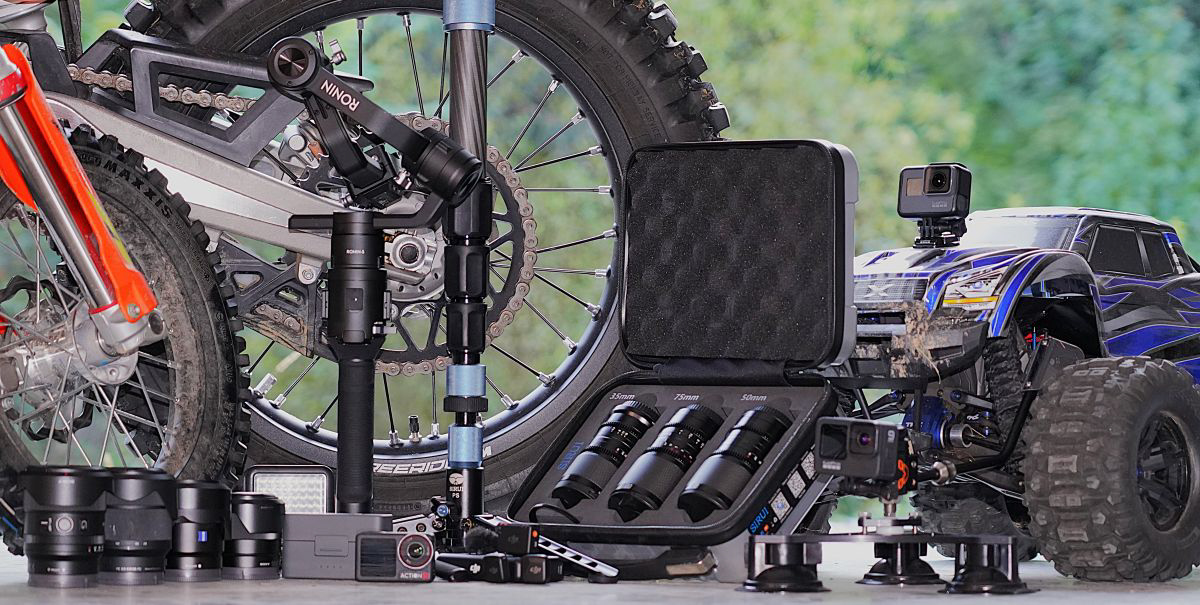
My stabilization journey went through three different versions of the Steadicam, and using one well was as much a physical skill as it was a piece of equipment. Every camera setup meant carefully balancing the rig with counterweights, making small adjustments until it would float properly, and then supporting all of that weight through an arm brace while trying to keep my movements smooth. It worked remarkably well for its time, but getting the shot required a bit too much work long before I ever pressed Record. Moving to the DJI Ronin motorized gimbal felt like jumping forward a generation: electric motors actively stabilized the camera instead of relying almost entirely on mechanical balance, counterweights, and my ability to control the rig. There is still setup, balancing, and technique involved, but the Ronin made it much faster and easier to go from “I want a moving shot” to actually filming one, especially when working alone or when the shot wasn't important enough to justify spending a bunch of time setting up a Steadicam.
Lens Preferences
My main lens, which I use 80% of the time, is the Sony FE 24-105mm f/4 G OSS. This is my do-everything lens because the zoom range gives me plenty of options for on-the-fly decisions without constantly changing lenses. At 24mm, I can capture a wider scene or work in tighter spaces, while the longer end lets me tighten the frame for details, portraits, and B-roll. The constant f/4 aperture also keeps things predictable while moving through the zoom range. For the way I shoot, especially when I don't know exactly what the next shot will be, this lens usually stays on the camera.
I also have a small selection of prime lenses that I use for more controlled and staged settings. Giving up the convenience of a zoom makes me more deliberate about camera position and composition, but primes can give me faster apertures, stronger subject separation, and a different look from my everyday zoom. I don't need a huge collection of them. A few carefully selected focal lengths cover the basics and provide enough variety to make an edit look more sophisticated.
But for pure, over-the-top cinematic edits, I enjoy the Sirui Anamorphic T2.9 1.6X Neutral Flare kit with 35mm, 50mm, and 75mm lenses. Anamorphic isn't just about creating a wider image. These lenses actually change the character of the shot. You get a wider sense of the environment around the subject, oval-shaped out-of-focus highlights, distinctive horizontal flares, and some of the optical characteristics that have been associated with cinema for decades. The 35mm is my wider option when I want more of the environment in the shot. The 50mm gives me a more balanced perspective for medium shots, while the 75mm lets me tighten things up for details and stronger subject-focused shots. Together, the three focal lengths let me change the composition while maintaining the same anamorphic character throughout an edit.
On the Sony Alpha preview screen, the anamorphic image is "squished." You can work around this with an external monitor, but that increases the camera's profile and can sometimes be too cumbersome. Planning the shot becomes a little more important when the preview screen isn't showing the proper aspect ratio. But after converting the footage in post, you see why I go through the extra trouble. You can crop regular footage into a wide aspect ratio and add black borders, but that only changes the shape of the image. It doesn't recreate what an anamorphic lens does optically. You can try, but it's just not the same. I may add an external monitor in the future. When I do, I will update this page.
One-Legged Beasts and a 6-Legged Slider
A good tripod (or four) is essential equipment. There is always a need for a locked-down shot for a talking head or B-roll. But monopods are my favorite. I have three awesome Sirui monopods in the product list above. They each serve a unique purpose. The model 325FS is the one I have and is currently a challenge to find new in stock. But they are out there. The model 325FL is the updated carbon fiber version. These monopods are great when you need a little bit of everything. They combine monopod movement with a deployable tripod base. The tripod base will also allow movement or completely lock down. And they are very discreet for locations that allow monopods but not tripods. When my position is frequently changing but the shots need to be solid, this is the one I choose. The model 326M is full carbon fiber, extremely light, and extremely useful. I think of it as stable handheld pan-and-tilt movement minus the vertical shake. No, it's not handheld, but it offers me similar freedom while making my footage more stable. The height adjusts fast, so making decisions on the fly is not cumbersome at all. Unlike the other two monopods, this is the one you can run with, changing your location and making adjustments rapidly for a "one camera looks like two" type of production. There is no tripod base or a bunch of adjustments. It's just a three-section monopod that feels great in the hand. If I had to pick only one monopod, this would be it. I have a Kamerar Slider that I bought at the NY Photo Expo back in 2015. It has adjustable feet attached. Both sides can be mounted to a tripod for adjustable elevation and pitch with six legs of stabilization. This is for when I need to simulate a short-distance dolly-style shot. It's a real slick setup.
Chasing Gear
Just like with motorcycles, it is really easy to fall into the trap of chasing gear. When I used to film teams at a local racetrack, I went through the phase of chasing camera gear too. You can check out the Legacy Motorsports Media playlist on our YouTube channel.
Outdated or Proven?
I eventually ended up with what worked well for my style, which is the gear that I have today. Some say my gear is outdated; I would say my gear is proven. Because some of the gear is no longer in production, I have posted links to comparable items that are currently available.
For motorcycle-specific video gear, make sure to visit our Pure Sound / MotoVlog page. Our long-form Pure Sound videos are posted on our YouTube channel. Our short-form teaser reels are posted on Instagram.
Follow us on social media to see our bikes and where we are on the motorcycle journey now. We would love for you to ride with us in the comment section and join the discussion. On YouTube, our main channel, YouTube.com/HazardSports, is where you will find our full edits. YouTube.com/@HazardSportsMedia is our content creation channel, where we share behind-the-scenes content, videography, editing, and prop creation.